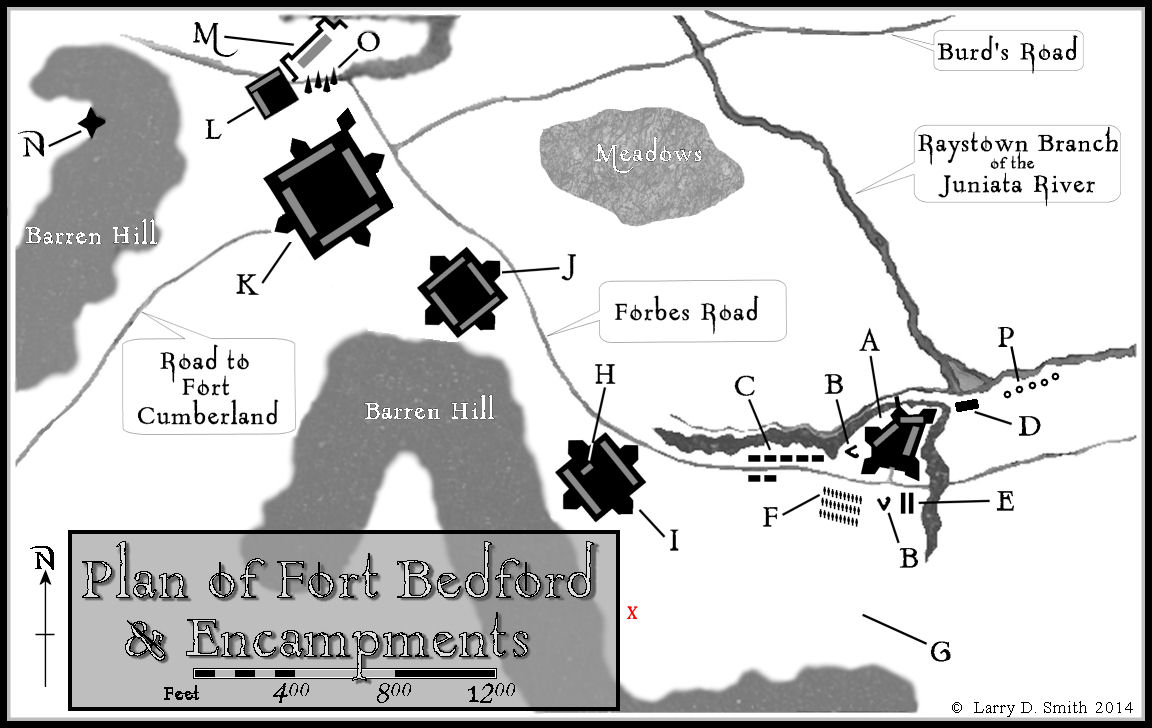
One of the benefits of the French and Indian War in this frontier region of the Colony of Pennsylvania was, in 1771, the erection of the County of Bedford.The cutting of the military road known as the "Forbes Road" contributed directly to the movement of Euro~American settlers into this frontier region to establish their homesteads in the wilderness. As the population increased, the need for another county became evident.
A second benefit was the construction of Fort Bedford. It would be used, during the 1770's by the Bedford County Militia in the American Revolutionary War.
The plan above shows the fort (A), two earthen redoubts (B),numerous cabins and huts used by the suttlers who accompanied the army (C), the landowner, GArret Pendergrass's trading post (D), two hospital buildings(E), parade grounds (F & G), the fort commandant's house (H), encampment of Colonel Montgomery's Regiment (I), encampment of the Maryland and North Carolina Regiments and the Pennsylvania 3rd Battalion(J), Colonel George Washington's field artillery and the Pennsylvania 1st and 2nd Battalions (K). the encampment of the Royal American Regiment (L), the Provincial Train (M), the Indian camp (O) and bake ovens (P).
Although not shown on this plan, the powder magazine would have been located in the vicinity of the red "X".
Notice Forbes Road running past the south wall of the fort.
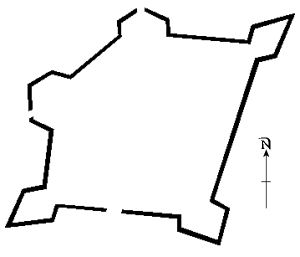
The image above shows the outline of the fort as drawn on a 1763 plan by John Rocque, an influential Eighteenth Century cartographer.
The stockade wall of Fort Bedford was constructed in the same manner as most British forts at the time. First, a V-shaped ditch, which was four to five feet deep and about three feet wide at the top, was dug along the perimeter of the entire fort. A number of the troops were employed in digging the ditch while others were set to work felling trees in the surrounding forests. If available, oak was the preferred wood for use in the stockade wall. Oak is resistant to fungus and insects because of its high tannin concentration, and therefore oak logs would weather well and not require replacement due to natural deterioration for many years. Oak is also difficult to set on fire ~ a quality desirable in a stockade wall. The layout and structure of Fort Bedford was no different than any other contemporary provincial fort. The idea was to make the enclosing wall impregnable from the outside, but easily defended from the inside. The construction of a stockade, i.e. a fort constructed of upright logs, during the Eighteenth Century, required the services of a skilled ax-man. Trees with relatively straight trunks, measuring at least eighteen feet in length, would be felled, or chopped down. That was simple enough for any man who was strong enough to swing a felling ax. Then each felled tree was cleaned of any and all branches so that the resulting log would be able to be placed side by side with others as tightly as possible. But it was not simply a matter of standing each felled and cleaned log upright and assuming the work was done. The logs needed to be squared and hewn flat on two opposing sides so that each log would fit snugly together with its neighbors in the wall. Working on the log as he would on one to be used in the construction of a house or barn, an ax-man, using the felling ax or a hatchet, would score the log, i.e. he would hew, or cut, a series of deep vertical slashes a few inches apart along the entire length of the log. Then a broad ax would be used to chip out the wood between the slashes. The result would be a somewhat level, flat surface running the length of the log. An adze might be employed to ‘smooth out’ the marks left in the scoring and chipping of the log if it was intended for a dwelling, but in regard to a fortification, time would probably not have been wasted on that process. Directly opposite the first side, another side would flattened and straightened by the ax-man. Theend of each log which would be considered its ‘top’ end would be hacked into a point. The squared logs would be stood upright in the V-shaped ditch, flat sides touching one another. Then laths, i.e. small thin boards, would be spiked or nailed to two or more upright logs near their tops to hold them together, although the available evidence does not note if that was the case at Fort Bedford. It has been estimated that the fort's stockade wall would have required at least 2,000 such logs. The ground that had been excavated from the ditch was pushed back in against the upright logs’ bases and tamped down tight.
Following the completion of the wall, a platform perhaps only six feet wide was constructed against the inside of the wall, running roughly the entire length of the enclosing stockade. This platform would have been perhaps four to five feet off the ground. The platform would allow the fort's garrison to have an elevated vantage point over any attackers through loopholes cut between the logs at points between ten and twelve feet above the exterior ground level. Attackers would not be able to easily poke musket barrels through the loopholes at that height. Swivel guns were mounted to fire through certain of the loopholes.
According to maps of the fort, three log buildings were constructed inside the walls of the stockade. Initially one would think that such buildings would have been used as soldiers' barracks. But the primary purpose of the fort near Raystown was to serve as a protected supply depot during the Expedition. By understanding that, the discovery that the three buildings constructed inside the stockade were intended to serve as storehouses does not seem so unusual. The storehouses would prove to be necessary due to the immense quantity of supplies that the army would need on the expedition. In a letter to General Forbes, Bouquet noted: "We have storehouses to hold 3 months' provisions for the army, and we shall build some for the baggage, etc.” The three buildings, at least one of which possibly measured 120 feet in length and twenty-five feet wide, proved to be inadequate for the army's storage needs over the course of the next year, as was noted in a letter Lieutenant Ourry wrote to Colonel Bouquet. According to maps of the fort, three log buildings were constructed inside the walls of the stockade. Initially one would think that such buildings would have been used as soldiers' barracks. But the primary purpose of the fort near Raystown was to serve as a protected supply depot during the Expedition. By understanding that, the discovery that the three buildings constructed inside the stockade were intended to serve as storehouses does not seem so unusual. The storehouses would prove to be necessary due to the immense quantity of supplies that the army would need on the expedition. In a letter to General Forbes, Bouquet noted: "We have storehouses to hold 3 months’ provisions for the army, and we shall build some for the baggage, etc." The three buildings, at least one of which possibly measured 120 feet in length and twenty-five feet wide, proved to be inadequate for the army’s storage needs over the course of the next year, as was noted in a letter Lieutenant Ourry wrote to Colonel Bouquet.
The location of the stockade fort on the small hill overlooking the Juniata River was strategically sound, but access to the river might be necessary. A stockade walled stairway was constructed from the bastion located in the center of the north wall to the base of the cliff and river's edge. Loopholes were cut into the stockade walls lining the steps, so that anyone approaching along the river bank could be fired upon.
The location of the stockade fort on the small hill overlooking the Juniata River was strategically sound, but access to the river might be necessary. A stockade walled stairway was constructed from the bastion located in the center of the north wall to the base of the cliff and river's edge. Loopholes were cut into the stockade walls lining the steps, so that anyone approaching along the river bank could be fired upon.
There exists no document that provides a definitive date for the completion of, or the naming of, Fort Bedford. In his letters, Colonel Henry Bouquet, who superintended the actual construction of the fort, did not state, at any time, that the stockade fort was completed. On 11 July, in a letter to General Forbes, Bouquet noted that: “The fort progresses, in spite of the difficulties in digging in several places in the rock. We have storehouses ready for three months’ provisions, and more than a third of the stockades are in place.”203 An assumption can be made, though, that it was near completion at least by 08 August 1758 due to the manner in which Colonel Bouquet dated his letters. Prior to that date, Bouquet provided the dateline: Camp Near Raestown; whereas on that date and thereafter, he noted: Raes Town Camp. [It should also be noted that Bouquet himself never used the name: Fort Bedford; that name was not publicly associated with the fortification until December 1758, when the trader, Adam Hoops used it in a dateline on a letter he sent to Colonel Bouquet (who was then at Fort Ligonier).] The wording of the letter written on 17 July and published in the 24 August issue of the Pennsylvania Gazette (in which it was stated "A strong Fort is building…") suggests that the fort was not completed at that time. But that is an assumption based on the only evidence available: the fact that the wording "is building" constitutes a verb that is not in the past tense, but rather in the present-tense, implying 'ongoing construction.' As is often the case, in the absence of facts, assumptions may be made, but it is important that they be noted as such, and for the reader to realize that an assumption would not be needed if the true facts were known. Hugo K. Frear, the author of the souvenir book Fort Bedford Bicentennial published in 1958 assumed that, according to a letter dated 16 August 1758, from Captain Joseph Shippen, to Richard Peters, that the fortification’s date of completion coincided with that date:
The unfortunate thing for historical accuracy is that recent historians have made assumptions, based on assumptions made by earlier historians: a fact that is overlooked. An article titled: The Etymology of Bedford was published in the January 1992 issue of The Pioneer, the quarterly newsletter of the Bedford County Historical Society. Instead of finding a contemporary source to reference, the author utilized only previously published books. The reference for the information contained in the statement: “To General Stanwix belongs the responsibility or credit in changing the name of this fort from 'the Fort at Raystown' to the Fort Bedford, which change appears by a letter from General Stanwix, dated August 13, 1759, to Governor Denny, this being about one year from the date of the building of the fort." was derived from Howard Blackburn's History of Bedford and Somerset Counties, Pennsylvania, which, itself, was based on an assumption. References from The Kernel of Greatness, Hugo Frear's Fort Bedford Bicentennial and Annie M. Gilchrist's Bedford, Pennsylvania were also quoted, all of which were based on assumptions. As noted above, the first instance of the use of the name Fort Bedford occurred in December 1758 (the actual day's date was not recorded on Adam Hoops' letter). Prior to 13 August 1759 (when it has been claimed that General Stanwix initially named the fort), the name the phrase "Camp near Bedford" was used on two separate letters.
General Forbes wrote to Colonel Bouquet on 25 May, in which letter he stated: “Your Making a provision for a Generall Hospital at Rae’s Town is very right it will in the meantime always answer for some use or other.”177 The hospital, which consisted of two buildings, was built outside of the stockade,,to the south of the southeast bastion. According to one account, the larger of the two buildings measured 100 feet in length and 20 feet wide. It was divided into ten small rooms, each of which was supplied by a fireplace, with two adjoining rooms’ fireplaces sharing a common chimney. The second building was smaller and consisted of only five rooms, without fireplaces.
As noted previously, the three buildings that are often depicted in plans of the fort are most often labeled as 'storehouses'; the primary purpose of the fort was to serve as a distribution point for supplies to the army. And it wasn’t just supplies that were stored at the fort. An inventory of Indian Goods, meaning 'trade goods' was taken at Fort Bedford on the first day of January 1759. The heading noted that it was An Account of Indian Goods in the Kings Store House at Fort Bedford:
20 Guns wth Locks
5 Ditto without
99 Dozen & 8 Glasp Knives
21 Dozen & 8 Scalping Knives
23 Gun Locks
15 Pound of Thread
13 Peices [sic] of Gartring 60 yards
19 Peices of Yellow Binding
2 Pound & 1/2 of Wire
3 Hundred Flints
2 Grose of Aul Blades
1 Doz: 1/2 Screw Boxes
12 Doz: & 9 Jews Harps
1 remnant of a Peice of White Linn abt 3 Shirts
26 Check Shirts
22 Silver Laced Hatts
16 Tin Quarts
45 Tin Pints
14 Yard of Flannel Striped
110 Cutlass’s
2 Pistols
15 Peices of Half Thicks
7 Yards Ditto
11 Britch Clouts
9 Strouds
3 pair of Half thick Stokings
8 Pound of Vermilion
200 Pound Tobacco
500 Hatchets
1 Box of Bullets abt 60 Pound Wt.
1 Do of Do 40 Do
1 Do 30 Do
2 Casks of Lead 500 Pound Each
4 Boxes of Barr Lead
1 Box Swan Shot 6 Baggs
10 Yards of Callico
4 1/2 Pound of Black & White Beads
30 Dozen of Rings
3 Dozen of Sholder Buttons
46 Pipe Tomahawks
518 Blankets
60 English Match Coats
80 White French Do very Coarse
120 Brown French Do very Coarse
19 Silver Hair bobs
26 Silver Gorgets
4 Wrist Bands
600 White Wampum
Some of the items in the foregoing list might need explanation. The 'gun locks' refer to matchlocks, which were the firing mechanisms of a musket, in which the spark to the black powder was provided by a 'slowmatch' i.e. a smouldering length of hemp rope. The name 'glasp knives' would be more recognizable as 'clasp knives. The 'glasp knives' were folding knives resembling modern-day pocket knives. The 'gartring' refers to material used for garters, usually, though not noted here, consisting of thin leather. The 'aul blades' refers to a type of punch, an 'awl' used primarily by cordwainers to poke holes in leather. The 'jews harp' was an inexpensive and easily learned musical instrument. According to the Royal Warrant of 1768 for Infantry Cothing, Colours &c, issued by the King of Great Britain, called for "hats to be laced either with gold or silver. . . and to be cocked uniformly." The tin 'quarts' and 'pints' refer to measuring containers fashioned like mugs or tankards. The 'cutlass's' refer to short broadswords; the pistols are self-explanatory. The 'britch clouts' refer to breechclouts, the Amerindian substitute for trousers. 'Stroud' refers to red colored broadcloth. 'Vermilion' is a red dye, explaining how the 'redcoats' gained their color. The 'swan shot' refers to irregular shaped bullets not produced in a bullet mold, but rather by letting molten lead drip through holes bored in the bottom of a bucket, cooling as they dropped into water. The 'match coats' (English, White French and Brown French), refer to a type of blanket worn over the shoulders, like a mantle, by the Amerindians. 'Gorgets' were a crescent-shaped piece of metal worn at the front of the neck/upper chest, much like a necklace. They were the last vestige of plate armour worn by the Medieval knights. Although they served no purpose other than the symbolism of nobility, small versions of the gorget were prized by the Amerindians. In regard to the item listed as 'silver hair bobs', men of that age sometimes grew their hair long, but pulled it back into what we would today call a 'ponytail'. In the 1700s the style was called 'bobbed', and the silver hair bobs listed here might refer to an object to hold the hair together at the neckline.